
Jason Mohoney (MIT CSAIL) presented Agents for Scientific Computing at the CERN EP-IT Data Science Seminar on March 17, 2026.
The talk covered the mechanics of AI agents — retrieval, tool use, and orchestration — and argued that their immediate value in scientific computing lies in low-risk tasks like documentation search, code generation, and debugging, rather than full automation.
Archi in CMS Computing Operations
Archi is deployed as a prototype assistant for CMS Computing Operations, where operational knowledge is scattered across wikis, JIRA tickets, Redmine, and runbooks. The system ingests these sources into a Postgres-backed vector store and uses a ReAct-style agent loop to retrieve context and answer operator questions with cited sources.
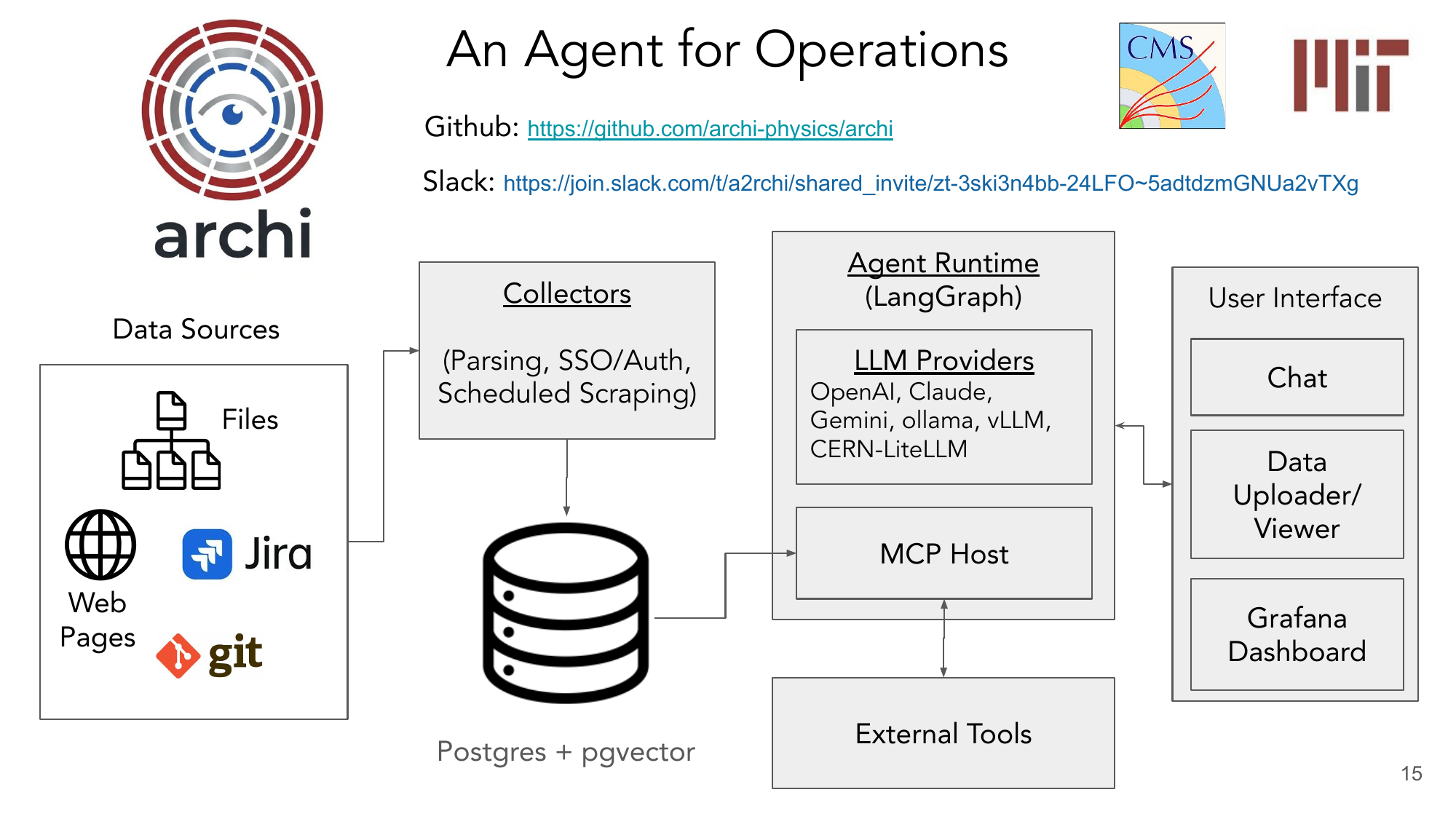
The deployment follows CERN’s data privacy guidelines: personal identifiers are stripped via an anonymization pipeline, models run through CERN LiteLLM or OpenAI with data collection opt-out, and the system supports access control and local model hosting.
Usage and feedback
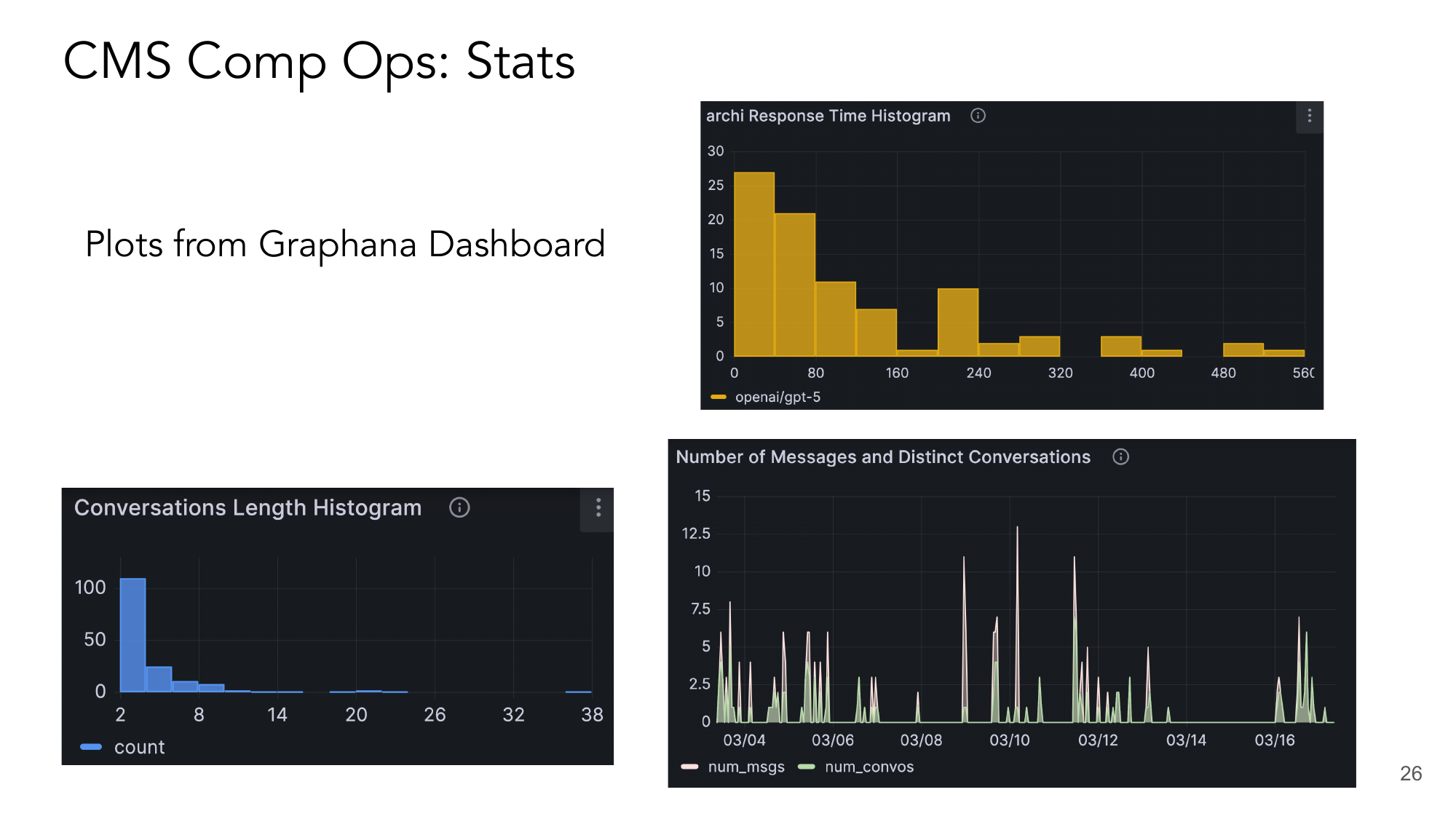
Early usage data from the Grafana dashboard shows response times and conversation volumes. User feedback identified areas for improvement — retrieval bugs when users paste JIRA links, missing capabilities like web search, and edge cases in data anonymization — all of which are being addressed in subsequent releases.
What’s next
The talk outlined two directions under active development: automating routine operations tasks (ticket triage, root-cause analysis) and building a cooperative agent for HEP physics analysis that augments coding agents with domain-specific knowledge from Archi.